Washington State University Internationalization Lab Final Report: Pathways to Student Success and Scholarly Impact in a Global Context
Executive Summary
Guided by the American Council on Education’s (ACE) Internationalization Lab process, a broad-based committee of WSU administrators, faculty, and international education professionals assessed WSU’s current level of internationalization and formulated recommendations that will allow WSU to make sustained progress toward comprehensive internationalization. Data from multiple sources, especially benchmarking data made available from a national study by ACE, were used to determine realistic goals and strategies that our university can begin to implement immediately to increase our positive impact on our students and our world.
This report focuses on three achievable goals:
- Prepare students for life and work in a global context. Some of the key elements envisioned for achieving this goal include coordination of internationalization goals with UCORE, increasing international enrollment system-wide, and growing participation in study abroad by making access to it more equitable.
- Maximize international opportunities for scholarly and educational collaborations. Foundational to achieving this goal is improving support for international engagement by WSU faculty and increasing productive visits by international scholars. Information sharing on lessons from successful collaboration and removing barriers to international collaborations and exchanges are key strategies to promote faculty research collaboration, which can lead to opportunities for students to participate in international research, outreach, and other co-curricular opportunities.
- Establish an internationalization culture strongly connected to WSU’s mission and strategic planning. To sustain an internationalization culture, we must assess and track our progress based on metrics that support our overall system strategic plan. A strategy that has helped other universities establish and maintain a culture of internationalization is to systematically build relationships with international alumni who can open doors to opportunity for research, assist with student recruitment, and increase WSU’s brand recognition around the world.
The cornerstone of the strategies used by our aspirational peers to build and sustain internationalization is the establishment of a standing internationalization committee. The committee should have broad, system-wide representation of stakeholders and receive input from employers of WSU graduates. The standing committee can be charged with coordinating issue-specific working groups, identifying metrics to gauge progress, and developing plans for curriculum coordination, faculty, and scholar support, and embedding internationalization within fundraising and alumni strategies.
Internationaliztion: What, Why, and How
Our university’s vision, clearly proclaimed in our system strategic plan, states that WSU will deepen and expand its impact by building on the strengths of each campus and location for a stronger Washington state and global community. Particularly in a state like ours, which is highly connected culturally and economically throughout the world, helping to build a stronger Washington and having a positive global impact are inseparable. Thus, like other land grant Research I universities, Washington State University is increasing international recruitment efforts, working to expand global learning activities, such as study abroad and student exchanges, and creating global partnerships designed to enhance university education, research, and outreach. While these efforts are coordinated and facilitated by the Office of International Programs, our current level of global impact is a product of the excellent work of faculty and staff across multiple campuses and colleges. Building on this strong foundation, we can achieve further success in the internationalization of WSU, and therefore better fulfill the WSU vision, by ensuring that a global perspective is embedded in the culture of colleges, campuses, and administrative units across the WSU system.
The American Council on Education (ACE) provides national leadership assisting colleges and universities achieve comprehensive internationalization through the ACE Internationalization Lab [acenet.edu/Research-Insights/Pages/Internationalization/CIGE-Model-for-Comprehensive- Internationalization.aspx]. ACE’s model of internationalization of universities follows in part from the implications of pervasive “movement and interdependency of ideas, people, goods, capital, services and organizations as well as threats across borders.” In this global context, comprehensive internationalization of universities “is a means for understanding and advancing human and technical connectivity; fostering local and global interdisciplinary research and teaching; supporting social, economic, and civic development; and propelling higher education forward as an equitable and agile public good.”
To chart a course for broad-based internationalization at WSU, we participated as a member of the 20th cohort of the ACE Internationalization Lab. Our participation in the Lab made WSU one of more than 175 institutions that have made a serious and sustainable commitment to internationalization that advances their core mission. With guidance from ACE, and a broad-based committee of faculty and administrators from across the WSU system (see Appendix A), we assessed WSU’s current level of internationalization, developed strategies for making our internationalization more comprehensive, and designed the means to assess our ongoing progress.
Assessment of WSU’s Current Level of Internationalization
A core activity of our ACE Lab participation was a benchmarking exercise that allowed us to compare WSU’s efforts at internationalization with responses collected from a comprehensive survey of U.S. universities conducted by ACE in its 2022 study, Mapping Internationalization on U.S. Campuses [acenet.edu/Documents/Mapping-Internationalization-2022.pdf].
Success in these efforts requires that an international perspective is embedded in the culture of colleges, campuses, and administrative units across the WSU system.
Particularly helpful was a report comparing responses across all universities with those of a group of peer and aspirational peer universities we selected (See Appendix B). Several important insights emerged from our benchmarking exercise, and these are summarized in Table 1.
Table 1. Key Findings from the ACE Benchmarking Exercise
| Issue | Selected Peer/ Aspirational Peer Group | Entire Sample of Universities | WSU |
| Primary reasons for internationalization | (a) Improving student readiness for a global era (b) Having a greater diversity of students, faculty, and staff (c) Becoming a more attractive environment for prospective students. | The same three reasons were endorsed by the whole sample. | Consistent with our goals |
| Have developed a formal strategy to raise money to support internationalization | 66% | 18% | No formal strategy |
| Demonstrated institutional commitment through establishment of a continuing representative committee focused on advancing internationalization and assessing progress | 89% | 40% | No standing committee |
| Internationalization of the curriculum | 83% used a multi-level strategy with efforts made at the institution, college, and departmental levels | 27% used a multi-level strategy that included all three levels: institution, college, and department. | Some coordination across levels but mainly left to individual departments and course instructors. |
| Financial support of faculty and students for engaging in: (a) internationalization of programs (b) studying or conducting research abroad | Support provided (a) 78% (b) 89% | Support provided (a) 32% (b) 43% | WSU support is ad hoc rather than consistent and strategic. |
Informed by these data and other assessment efforts, our ACE Lab Leadership Committee and subcommittees provided recommendations around three domains of internationalization: (1) Institutional Commitment and Policy, (2) Curriculum and Co-Curriculum, and (3) Partnerships and Student & Faculty mobility. Their recommendations are synthesized below with a particular emphasis on concrete next steps to achieve the university’s internationalization aspirations.
Internationalization Goals and Strategies at WSU
Realizing WSU’s global impact vision requires a coordinated effort that focuses on three high-level goals.
In our highly interconnected world, it is critical that all students graduating from WSU possess the skills needed to navigate diverse teams and interact and negotiate with people from different parts of the world with different cultural assumptions. That level of global understanding can be achieved if we ensure that WSU students are personally exposed to international perspectives in multiple, complementary ways.
WSU’s impact globally, and within Washington State, will be enhanced if we assist our scholars and students in connecting with strong international collaborators and meaningful opportunities for scholarship and global outreach.
To positively impact our region and global community requires that internationalization becomes a core feature of our university culture that is reflected in strategic plans and initiatives. A necessary feature of establishing an internationalization culture is that we assess our efforts and integrate relevant metrics as a part of WSU’s overall system strategic planning and reporting processes.
Of course, our efforts toward achieving each of these goals must recognize that the university continues to face significant budgetary challenges. Fully meeting our aspirations for the three internationalization goals will require new investments over time, but it is critical that WSU not wait for an improved budget environment to accelerate our comprehensive internationalization effort. We can look to the insights from the benchmarking exercise summarized in Table 1 to enhance internationalization of WSU without taking resources from other priorities. In fact, in some cases our internationalization efforts can produce additional revenue.
Washington State University will deepen and expand its impact by building don’t he strengths of each campus and location for a stronger Washington state and global community.
Pathways to Preparing Students for Life and Work in a Global Context
Coordinate UCORE offerings with our internationalization goals. Preparing students as global citizens can be supported by advising them to enroll in UCORE courses with global engagement content, and by highlighting the importance of a global perspective in career preparation. A concrete step for beginning this effort would be the creation of an International Studies Certificate that can be earned from within WSU’s UCORE offerings or equivalent honors program coursework. This certificate could enhance the record of students whose aspirations are globally oriented from many different majors.
Increase study abroad engagement by making it a more inclusive and equitable opportunity. Many kinds of global learning opportunities, from short-term faculty-led programs to full semesters abroad, can be a transformative student experience. Currently, about 800 students across the WSU system take advantage of study abroad opportunities each year, though most of the students who study abroad are from the Pullman campus. Cost is a major barrier for many students, but this problem can be
addressed by including funding for study abroad scholarships as part of our more general scholarship fundraising effort. For example, a donor interested in funding a scholarship in a particular college or department could be requested to ‘top-off’ the gift with funds that would allow the recipient to take part in a study abroad experience. Beyond cost issues, global learning participation could also be increased by providing more training on faculty-led programs, including mentorship from faculty who have led successful programs. Coordinating the efforts of global learning advising in International Programs with academic advising throughout WSU could also increase the pool of interested students and counter the misconception that studying abroad will delay graduation. For example, if academic programs establish curriculum mappings with partner universities and integrate them into student advising, students could be guided toward study abroad opportunities more efficiently and effectively.
Increase international student enrollment on our campuses. Increasing the number of international students has an important educational benefit by exposing all WSU students to other cultures and perspectives, as well as an economic benefit in terms of tuition revenue, especially given the demographics of the U.S. Consequently, recruitment of international students is a highly competitive endeavor not only among U.S. universities but also with universities in Canada, the UK, and Australia. WSU has made significant strides in the past several years in updating our international admissions infrastructure and processes and becoming successful in new markets we had not emphasized previously. Targeted initiatives that recognize the distinctive mission and culture of each campus could be used to increase international enrollment systemwide. Some possibilities include:
- Build cohorts of students through affinity groups by identifying specific countries where reciprocal partnerships can be developed and defined.
- Recognize the unique climate and distinctive academic strengths on each WSU campus and tailor student recruitment and retention strategies to provide a “home away from home.” This effort could include creating student cohorts recruited from community colleges in the region of a particular WSU campus.
- Identify creative use of targeted tuition waivers to leverage admission offers most likely to yield students for a particular campus.
- Ensure that international student orientation, advising, and English language support are robust across the system.
- Incentivize international student growth by sharing resources with programs that increase enrollment and by reinvesting a portion of revenue from growth in expanding recruitment efforts.
Curricular efforts, study abroad, and increasing international representation on our campuses are key pillars of student success in a globally interconnected world. Success in each of these areas can themselves enhance, and be enhanced by, the second major goal of internationalization: a comprehensive effort to broaden and deepen faculty and student opportunities to engage the world.
Maximizing International Opportunities for Scholarly and Educational Collaboration for Faculty and Students
In recent years, WSU has been expanding its international partnerships, particularly in Africa and Europe, but we have not yet achieved high visibility on the world stage. For example, the widely used Times Higher Education World University Rankings place WSU in the 301-350 range. All such ranking systems have their limitations, but these rankings influence who is interested in partnering with WSU and the number of prospective international students interested in applying to WSU. To help us achieve our international goals it is critical that we take deliberate steps to increase our impact and visibility globally through opportunities for scholars and students to engage with partners around the world.
Support faculty and visiting scholars to increase their impact. Supporting the global impact of our scholarly research and creative activity is critically important because it enhances extramural funding portfolios, increases awareness of WSU’s scholarly and creative work, builds a global brand enhancing international student and faculty recruitment, helps foster private sector partnerships, and provides student opportunities consistent with the land grant mission (e.g., Reed & Rudman, (2023) Sust Sci 18:967-981; Gamoran (2023) Edu Policy 37: 31-55; Hird & Pfotenhauer, Research Policy 46 (2017) 557–572; Seeber et al. Higher Ed 72 (2016) 685-701). A best practice common to universities with high global impact (e.g., Stanford, Penn State, Michigan State, and Purdue) is the creation of a team that coordinates activities across the university to allow faculty to develop and manage major international projects. These coordinating teams have been developed because the logistics of major international projects can discourage colleges and their faculty from attempting grant applications for large-scale international projects. Moreover, federal compliance and reporting regulations around international partnerships place an increased burden on universities with high risks of compliance failures for projects on an international level. Likewise, information and logistics support need to be visible and readily available to ensure both outbound and inbound scholars have a great experience that can be leveraged to build or enhance partnerships.
Expand opportunities for students to participate in international research and outreach. Some WSU programs have had success with integrating international research and study abroad. Examples include the School of the Environment’s NSF-funded program in Latin America, the STARS (Student Training and Research Semester) jointly funded by NSF and the EU for studies in scientific computing, and the Allen School of Public Health’s partnership in Kenya. To make more such opportunities available, it is important that we work across administrative and academic units to make the budgetary issues, compliance challenges, and benefits gained accessible to all interested faculty. In addition, modest investments in faculty travel to meet potential partners face-to-face could lead to a higher success rate on funding applications.
Develop systemwide co-curricular international initiatives. Co-curricular participation nurtures leadership, teamwork skills, and communication, and it improves adaptability in diverse situations.
However, creating a co-curricular program, particularly one with an international scope, requires extensive collaboration to pinpoint engaging themes and determine the array of events or experiences integral to its structure. We recommend that a task force comprising faculty, students, and relevant administrators be formed to begin the process of implementing a systemwide co-curricular initiative that provides a template and proof of concept for building and assessing future efforts. The co-curricular committee or task force should encourage students to initiate and lead projects addressing these challenges by promoting creativity, innovation, and a sense of social responsibility. For example, in a Global Challenges competition teams of students, ideally including students from international partner universities, could propose solutions to key global challenges relevant to students and society, such as environmental sustainability, poverty alleviation, or health care accessibility. A modest amount of private or corporate philanthropic support could reward winning teams with travel to discuss solutions with relevant policy makers. In addition to the positive effect on student learning, this kind of co- curricular activity can be leveraged to build and sustain partnerships with faculty and students from other universities, which in turn enhances study abroad and research opportunities.
Establishing an Internationalization Culture Strongly Connected to WSU’s Mission and Strategic Planning
Embed internationalization into WSU’s strategic plan. Although WSU’s strategic plan states that global citizenship is a WSU value, internationalization as defined in this report is not explicitly stated as a system priority. To drive internationalization, we need to recognize that international engagement is important to the goals of the university and provide metrics by which our efforts will be assessed. As part of the efforts of our ACE Lab committees, we have had positive discussions about internationalization with the WSU Office of Strategy, Planning, and Analysis, and it will be important that representation from that office be involved in implementing recommendations from this report.
Create a collaborative climate for internationalization. Data relevant to international initiatives are not widely available or shared among academic and support units that could benefit from the data. Metrics in a strategic plan can help promote data collection and sharing, but to create a climate for collaboration we recommend that WSU implement concrete projects that have broad benefits and provide a foundation for a pervasive culture of comprehensive internationalization. In addition to the curricular, co-curricular, and research examples provided earlier, other examples include:
- Connecting with international alumni for development and recruitment initiatives. A number of universities have active alumni chapters that assist in recruitment, provide scholarships to students from their region, and open doors to collaboration with universities or companies in their countries (UCLA has a particularly well-developed program that we could use as an aspirational goal). International alumni have not traditionally been a focus of our alumni or development efforts, but we can begin to lay the foundation for such an effort.
- Coordinating global engagement priorities across our system to take advantage of the different locations and faculty strengths across our campuses. The diversity of faculty interests and geographic environments should be a strength in attracting students and visiting scholars, and in building collaborations with universities abroad.
Next Steps on Our Continuing Path to Comprehensive Internationalization
Some key general strategies commonly used by our aspiration peers hold promise for helping WSU make continuing progress on our three broad objectives of internationalization:
- Prepare our students to thrive in a highly interconnected world.
- Facilitate faculty and student scholarship and creative activity to have global impact.
- Establish and assess university-wide goals and metrics as part of WSU’s evolving strategic vision.
Based on the data in Table 1, the four key strategies that we recommend be adopted by WSU are:
Establish a permanent representative committee focused on advancing internationalization and assessing progress.
Adopt a multi-level approach to support and extend departmental efforts that Internationalize our curriculum and develop meaningful co-curricular opportunities so that all students systemwide become well prepared for the global context of modern life and careers.
Address barriers to international research and outreach and deepen WSU’s global impact.
Develop a formal strategy to raise money to support internationalization.
To maintain the momentum gained from our participation in the ACE Internationalization Lab, it is critical that we establish the standing internationalization committee as soon as possible. The committee should have broad college and campus membership (including students), and include International Programs, and the Office of Strategy, Planning, and Analysis. We also recommend reaching out to external constituencies including employers of WSU graduates for input on creating informal learning opportunities and skills needed by our graduates. The standing committee can be charged with coordinating issue-specific working groups, identifying metrics to gauge progress, developing plans for curriculum coordination, faculty, and scholar support, and embedding internationalization within fundraising and alumni strategies.
Prepare our students to thrive in a highly interconnected world. Facilitate faculty and student scholarships and creative activity to have global impact.Establish and assess university-wide goals and metrics as a part of WSU’s evolving strategic vision.
Drawing upon the subcommittee reports summarized above, there are several concrete goals to include in the committee’s charge:
- Promote formal and informal opportunities for global learning for all students. A useful starting point for planning both curricular and co-curricular initiatives is to consider connecting our learning objectives to the UN Sustainable Development Goals. [https://sdgs.un.org/goals]
- Start with UCORE coordination and a Global Challenges Competition.
- Use curricular and co-curricular opportunities to increase the breadth and depth of interactions among domestic and international students.
- Facilitate the identification of faculty champions who can help build momentum for internationalization.
- Develop processes to improve coordination among Office of Research, International Programs, and the central Finance Office to identify lessons learned from previously successful major international research projects to assist teams with new initiatives.
- Work with university and college leaders on strategies for fundraising for internationalization and work toward identifying international alumni networks to assist in student recruitment or the establishment of scholarships.
- Leverage existing projects and partnerships to increase global diversity of WSU through visiting scholars and opportunities for research and joint programs with global partners.
To maintaint he momentum gained from our participation in the ACE Internationalization Lab, it is critical that we establish the standing internationalization committee as soon as possible.
![]() Appendix
Appendix
ACE Internationalization Lab Subcommittees
Curriculum, Co-Curriculum, Faculty, and Staff Subcommittee
Committee co-chairs
Kathleen McAteer – Vice Chancellor for Academic and Student Affairs – WSU Tri-Cities
Courtney Meehan – Associate Dean – College of Arts & Sciences
Grant Norton – Dean of Honors College; Provost and Executive Vice President
Committee members
Joseph Iannelli – Professor – School of Engineering & Applied Sciences – WSU Tri-Cities
Sergey Lapin – Vice Chancellor for Research; Associate Director of Data Analytics – WSU Everett
Rishi Sharma – Director of Business Development – College of Arts & Sciences
Insook Webber – Scholarly Associate Professor of Languages, Cultures, and Race – College of Arts & Sciences
Kara Whitman – Scholarly Associate Professor – School of the Environment – College of Arts & Sciences
International Programs liaison
Kelly Newlon – Director of Education Abroad
Partnerships & Student/Scholar Mobility Subcommittee
Committee co-Chairs
Dori Borjesson – Dean of College of Veterinary Medicine; Provost and Executive Vice President
Jerman Rose – Director of International Business Institute (Ret.) – Carson College of Business
Committee members
Hanu Pappu – Professor Plant Pathology – College of Agriculture, Human, & Natural Resource Sciences
Ahmed Said Al Busaidi – Undergraduate Student – Carson College of Business
Mark Beattie – Associate Vice Chancellor – School of Hospitality Business Management – WSU Everett
Laurel Rea – Associate Vice Chancellor of Student Services – WSU Vancouver
Marwa Aly – Ph.D. Student in Chemical Engineering & Graduate & Professional Student Association Staff Assistantship
Marsha Quinlan – Professor of Anthropology – College of Arts & Sciences
International Programs Liason
Daniel Saud – Director of International Admissions and Recruitment
Institutional Planning, Leadership and Policy Subcommittee
Committee co-Chairs
John Roll – Vice Dean for Research – Elson Floyd College of Medicine – WSU Spokane
Tammy Barry – Vice Provost for Graduate & Professional Education; Provost and Executive Vice President
Committee Members
Doug Call – Senior Vice Provost; Provost and Executive Vice President – College of Veterinary Medicine
Sandra Haynes – Chancellor – Office of the President – WSU Tri-Cities
Laura Hill – Senior Vice Provost
Dipra Jha – Associate Dean for Equity & Inclusion – Inclusive Pedagogy – School of Hospitality & Business Management
Kevin Murphy – Professor of Crop and Soil Sciences – College of Agriculture, Human, & Natural Resource Sciences
Stephen Bischoff – Director – Dean of Students
International Programs Liason
Kate Hellmann – Director of International Student and Scholar Services
Curriculum, Co-Curriculum, Faculty, and Staff Subcommittee Recommendations
Summary Recommendations
- Integrate curriculum internationalization for all undergraduate students, independent of academic major, through UCORE.
- Enable more opportunities for students to study abroad from short faculty-led programs to longer academic exchanges.
- Hold workshops/training for faculty to help develop faculty-led study abroad programs
- Develop philanthropic support for programs, specifically fund-raising support to increase study abroad scholarships within the College level portfolios
- Establish a development officer in IP
- Financially support faculty as we develop these programs, potentially develop a grant competition to subsidize site visits for newly proposed programs (visits)
- Encourage/support faculty to write foundation/govt grants to support these initiatives
- Develop systemwide, co-curricular, international activities and initiatives.
- Create Global Challenge, gain philanthropic support for the effort
- Engage regional industry. Alex Pietsch – WSU Cooperate Engagement – corporate.wsu.edu/contact-us/
Recommendation 1
UCORE – Global Engagement Certificate
Rationale
WSU’s strategic “Student Experience” goal enshrines the university’s commitment to preparing future leaders, scholars, and global citizens. The preparation of students as global citizens may also be supported by advising them to enroll in UCORE courses with global engagement contents, as all WSU students complete 31-35 credits of UCORE classes or equivalent honors programs. Since students may, in principle, select any UCORE course, establishing a “Global Engagement” certificate is proposed to encourage students to take global-engagement UCORE courses and recognize the global-engagement focus of such courses. The certificate would be a stackable credential to augment students’ transcripts and awarded to students who complete 7 global-engagement UCORE courses from 7 different UCORE knowledge fields or equivalent honors program.
Currently, the 31-35 credits of UCORE classes, or equivalent honors program, are distributed over knowledge fields:
| [ROOT] | [WRTG] | [DIVR] | [PSCI] |
| [COMM] | [ARTS] | [EQJS] | [SSCI] |
| [QUAN] | [BSCI] | [HUM] | [CAPS] |
According to the latest edition of WSU’s catalog, these UCORE fields offer over 200 courses focusing on international and global-engagement topics.
Not all these courses are offered every semester or on each campus. For the proposed “Global Liberal Arts Engagement” certificate to be available to students on any campus, a suitable subset of the global- engagement UCORE classes would have to be available to students every semester and on every campus, or at the very least made available to some campuses via distance broadcasts from other offering WSU campuses.
Although English has essentially become a de-facto international language, global citizens may exercise more appealing, compelling, and persuasive communication and leadership in diverse international societies by expressing themselves, however partially, in another language if they currently speak only one. Speakers of any language beneficially interpret non-native speakers’ use of their language as a sign of appreciation, respect, and interest, which fosters cordial and deep multicultural interactions. Perhaps one language course should be required or at least strongly recommended for students who would like to earn the proposed “Global Liberal Arts Engagement” certificate.
This objective may still be accomplished within the UCORE program for at least two languages, French and German, are currently taught in [COMM] classes: French 361 and German 307, 361. However, these are 300-level classes, which require previous prerequisite language classes that are not taken by non- language majors. It would thus be desirable to add to the UCORE program some classes on languages that do not require prerequisite knowledge of those languages; these classes may be incorporated within the [DIVR] and/or [HUM] fields. Should the development of these UCORE language classes be challenging, at the very least students should take Foreign Language and Cultures 101, a [HUM] class that introduces students to the world of languages.
Recommendation 2
Integrated Research & Study Abroad Programs
Rationale
Study abroad experiences widen students’ cultural horizons and contribute to graduating diverse internationally educated cosmopolitan professionals for transformative leadership in globalized, diverse, and multicultural societies. In consonance with WSU’s strategic “Student Experience” goal of ensuring that every WSU student has the opportunity to participate in study abroad experiences, “Integrated Research & Study Abroad Programs” are proposed to be institutionalized for every WSU major on every WSU campus. This proposal aims to fortify WSU’s commitment to global education by expanding current study abroad program offerings, minimizing financial and institutional barriers for both faculty and WSU students, integrating study abroad advising in student advisement as well as mentoring sessions between faculty and students, developing sustainable financial support for study abroad programs through grants and philanthropy, and providing training and faculty support for the development of new study abroad programming. Through this multi-pronged approach, WSU could create a more holistic and supportive environment for study abroad and substantially increase the number of WSU students who participate in these programs, contributing to the goal-2 metric in WSU’s strategic plan.
- Faculty training and support for program development
Although existing WSU Study Abroad programs offer valuable support to WSU programs and faculty interested in creating study abroad programs (i.e., longer-term exchange programs and/or shorter-term faculty-led programs), there is room for significant improvement. Many faculty are unaware that developing a study abroad program is an option, and for those who express interest, navigating the process can be challenging and unclear. Faculty may also encounter obstacles to the development of study abroad programs due to financial constraints, faculty appointments, and time limitations. To address these challenges, we recommend that WSU establish training sessions and workshops to engage faculty more actively in the development of study abroad programs. Offering financial incentives such as faculty time buy-outs or financial support (e.g., fellowships) for travel to intended study abroad locations can further encourage faculty participation and facilitate the development of on-the-ground relationships and contacts.
Faculty time buy-outs and other financial incentives (funded by grant and philanthropic support as noted in recommendation 2 below):
- Provide financial incentives through time buy-outs, allowing faculty dedicated time to focus on the development and implementation of study abroad programs without compromising their existing commitments and alleviate the burden on faculty by compensating for the additional time and effort required for planning and executing study abroad initiatives.
- Provide financial support for travel. WSU could provide financial support such as grants and fellowships to assist faculty in covering the travel expenses related to personally visiting, exploring, and establishing connections in the intended study abroad locations. This could also better enable faculty to build meaningful relationships and partnerships with other institutions in those intended study abroad locations.
- Potential workshops/trainings and mentorship
- Exploring Study Abroad. Workshops designed to assist academic programs in seamlessly integrating study abroad into their curriculum.
- Clarifying Faculty Lead Responsibilities. Workshops/training addressing the multifaceted roles of program faculty leads, covering aspects such as recruitment, administration, budgeting, representing WSU, and crisis management.
- Developing a Successful Study Abroad Program. Workshops focused on program leadership, providing essential information and resources to reduce barriers for faculty in developing study abroad programs. Topics may include creating program itineraries, tips for program success, budget development, collaboration with external program partners (e.g., AUIP), marketing and program promotion, and guidance on student financing (scholarships and grants).Developing Program-Level Grant and Philanthropic Support for a Study Abroad Program. Workshops/training focused on proving faculty insights into effectively seeking grant and philanthropic support (e.g., to reduce student cost) for study abroad programs by enhancing their understanding of potential funding avenues.
- Mentorship Program. A structured program that pairs new faculty program developers with experienced mentors who have previously created successful study abroad programs.
- Develop sustainable grant and philanthropic financial support for study abroad programs
Establishing sustainable grants and philanthropic support could greatly increase both faculty development of study abroad opportunities as well as student participation in impactful study abroad programs. This support would help to ensure longevity and continuity of study abroad programs as well as provide essential support for the planning and execution of impactful study abroad programs. We recommend that WSU actively seek financial support for scholarships for students as well as study abroad program development. This could be supported by hiring a full-time development officer in International Programs as well as by assisting WSU programs and faculty in finding and applying for appropriate grant opportunities for their individual faculty-led programs.
- Integrated advising and mentoring
Currently, it is mostly students who initiate the process of seeking a study abroad experience. They inquire with professors and academic and/or International Program advisors and then decide whether to pursue the opportunity. Each study abroad experience is essentially custom-made for each such student. The student collaborates with both an academic advisor and a global engagement advisor to formulate a list of overseas courses that provide academic credits that are both transferred to WSU and applied to the student’s WSU degree requirements, so that the study abroad semester does not delay graduation. This is a delicate and essentially ad-hoc process that is also repetitive and time-consuming, a major concern for academic advisors who generally manage large caseloads. Frequently, moreover, faculty curriculum committees may also become involved to evaluate syllabi of overseas-university courses for equivalence to counterpart WSU courses, which adds to the time consumed to approve the overseas courses in which to enroll each WSU student at a selected overseas university.
In WSU’s Reciprocal Student Exchange Agreements, WSU students on an exchange semester overseas pay their normal semester tuition to WSU and pay no extra tuition at the host institution. In return, exchange students from overseas pay no tuition at WSU, because the cost of their WSU attendance is covered by the tuition paid to WSU by the WSU students on exchange overseas. Since the number of overseas students who wish to complete an exchange at WSU currently exceeds the number of WSU students who complete a semester overseas, an imbalance may occur, which induces financial difficulties, complicates relationships with overseas partner universities, and limits the number of overseas students at WSU, which impairs the beneficial internationalization-at-home process.
Whereas students are generally interested in study abroad opportunities, not all WSU programs and/or not all campuses have been able to offer such opportunities to their students. This is mainly due to lack of information on opportunities and implementation on the part of faculty and academic advisors in those programs, e.g., Economics and Computer Science or Vancouver and Everett campuses.
Advising guides exist for majors and cohorts such as student veterans and have been publicized to academic advisors: ip.wsu.edu/global-learning/advising/advising-guides/.
- Integrated research & study abroad programs
The proposed “Integrated Research & Study Abroad Programs” addresses these challenges by integrating several study abroad components. To minimize the time consumed in advising students on overseas courses, the programs will establish “curriculum mappings” and integrate them in student advisement. The mappings will correlate courses at selected overseas partner universities with corresponding WSU courses in as many WSU majors as possible. In this manner, advisors and faculty can far more efficiently and effectively advise students toward study abroad opportunities, which in turn will contribute to an increase in the number of WSU students studying overseas.
The selected partner universities will be peer-comprehensive universities that offer educational and research programs like WSU’s, particularly in those WSU majors that have not yet engaged their students in study abroad experiences. As these overseas universities are acclaimed comprehensive research universities, e.g., Austria’s Technology University of Graz (a leader in education and research in all engineering and science fields), Denmark’s Aarhus University (top 100 university in the world), and Germany’s University of Cologne (a world leader in plant science for sustainable food security), their research programs and laboratories have attracted collaborations with WSU faculty. These WSU colleagues will then be able to recommend their research-team students to pursue a study abroad experience at any of these universities, which will increase the number of WSU students pursuing study abroad experiences. These experiences will encompass a research project jointly supervised by WSU faculty and their overseas counterparts, which will in turn sustain international research collaborations and engage students in contributing to publications as coauthors.
The benefits of study abroad experiences will be maximized by integrating cohorts of WSU and overseas students. With collaboration from our overseas university partners, the WSU students who will complete a study abroad experience will collaborate alongside those selected overseas students who will then complete an education experience at WSU. In this manner, these students will collaborate for two semesters, hence deepening their acquaintance and familiarity with one another’s diverse cultures and, upon graduation, become their own international professional network.
To increase the number of diverse students in study abroad experiences, particularly students from underrepresented populations, fellowships should be provided to these students to remove financial barriers that would preclude their participation in international research and education. Extramural funds to offer these fellowships have been secured from overseas universities, the National Science Foundation’s IRES program, a private foundation, and the Honors College. The proposed integrated programs will formalize and institutionalize these fellowships and leverage grants with funding sources.
The expansion of study abroad opportunities to all WSU colleges and campuses will be efficiently accomplished by establishing a senior leadership position that will connect WSU curricula and research with international programming and study abroad experiences. The incumbent of this position will need to be a current WSU faculty member with substantial global-engagement experience who already fosters international relations at WSU. In this manner, this colleague will be viewed as a peer by the WSU faculty and thereby be able to engage and discuss international education and research opportunities knowledgeably with campus chancellors and vice chancellors; with college deans, associate deans, chairs, faculty, and academic advisors in all colleges; and with the leadership in the Provost and International Programs offices. This incumbent will have already established global engagement relations with several WSU colleges and peer overseas universities and secured extramural funds to support global engagement. The incumbent will proactively promote international education and research collaboration opportunities at campus, college, and departmental meetings; contribute to advising students; develop and submit global-engagement grant proposals; assist colleagues in developing similar proposals; and collate successful grant proposals as templates for effective and rapid continuous development of such grant proposals.
An example of an existing “Integrated Research & Study Abroad Program” is the STARS.SE program at Linköping University in Sweden, funded by NSF’s International Research Experience for Undergraduates (IRES) as well as the European Union Erasmus+ programs, the Swedish STINT foundation and the Honors College. STARS.SE is an acronym that stands for “Student Training and Research Semesters” in Sweden. For the next three years, a cohort of 7 WSU CAS and VCEA students will study in Sweden for one semester and complete a research project. Each student will receive a $12,000 fellowship. During the fall 2023 semester, 8 WSU students actively participated in this program from 4 campuses: Everett, Pullman, Tri-Cities, and Vancouver.
Recommendation 3
Developing Systemwide, Co-Curricular, International Activities and Initiatives
Rationale
Participating in co-curricular programs is widely acknowledged and advocated as an essential component of student life. The globalized nature of the 21st century demands a comprehensive approach to education that extends beyond traditional classroom boundaries. By integrating co- curricular programs on an international scale, we can foster a more holistic learning environment, preparing students for success in an interconnected world. Co-curricular participation enhances holistic development by nurturing skills including leadership, teamwork, and communication, and helps to make new connections and adaptability in diverse situations. However, creating a co-curricular program typically requires extensive collaboration to pinpoint engaging themes and determine the array of events or experiences integral to its structure. This white paper advocates for the development of systemwide, co-curricular, international activities and initiatives as a means of enriching the educational experience.
- Create a co-curricular committee. It will be of utmost importance to establish a dedicated committee or task force that will be responsible for overseeing co-curricular activities. The committee should include representatives from various departments, faculty, students, and administration. There should be diversity in the committee to bring in different and global perspectives.
- Conduct a needs assessment. The initial step for the task force involves assessing the present state of co-curricular activities at WSU. This can be accomplished by employing surveys, interviews, or focus group discussions to gain insight into student preferences and requirements. Additionally, it’s crucial to ascertain the existing resources and potential obstacles that might hinder the introduction of new activities.
- Set clear objectives. A clear outline of the objectives of the co-curricular initiatives that need to be set up that align with WSU’s mission and goals, emphasizing global awareness, cross-cultural understanding, and the development of critical skills. To further enhance learning outcomes and provide a holistic educational experience to students, co-curricular activities should be aligned or integrated within the academic curriculum. Moreover, there is a need to encourage activities that span multiple disciplines to promote interdisciplinary thinking and problem-solving.
- Select global challenge initiatives. It is important to identify key global challenges and choose the ones that are relevant to students and society, such as environmental sustainability, poverty alleviation, or healthcare accessibility. The co-curricular committee or task force should encourage students to initiate and lead projects addressing these challenges, promoting creativity, innovation, and a sense of social responsibility.
Examples
- Lindsay Cannon, double majoring in Neurosurgery and French (class of 2018), became interested in medicine by volunteering with the Palouse Free Clinic in Pullman, which culminated during her study abroad in Dakar, Senegal. (She was a Fulbright semifinalist in 2018 & 2019 for a 9- month research grant to Senegal.) While there, she worked with the Global Research and Advocacy Group (GRAG), a public health research organization focusing on women’s and reproductive health, and eventually accompanied the team on fieldwork as a translator for a female genital mutilation and cutting (FGM/C) study. She was able to return to Senegal the following summer, thanks to a stipend given by Honors College, to continue working with GRAG. As their internship coordinator, she recruited and led a team of undergraduates to contribute to various initiatives including advancing and publicizing the results of the FGM/C study she had translated for the summer prior. The team shared the results of the study with key partners including UN Women, a crucial first step in using the results to influence health policy. This is an excellent example of how the financial support by Honors College made possible this student’s co-curricular international activities and contributions to the betterment of Senegalese women’s reproductive health care. Our tasks are then two-fold: Make this type of co-curricular international activities known to our students and help mobilize funding, private and public, intra- and extramural.
- During her senior year (2021), Lauren Hudson, double majoring in Biology and French, was awarded a Fulbright ETA (English Teaching Assistant) in Vietnam for 2022-23. Again, it is imperative that we proactively make students aware of the existence of such programs and help guide them through the application process.
- Pursue international collaboration. Establishing new partnerships with international educational institutions is needed to facilitate student exchanges, joint research projects, and collaborative programs. This can also be achieved via virtual collaborations leveraging technology, such as online seminars, joint workshops, and collaborative projects, enabling students to engage with peers globally.
Examples
- The Université de Lorraine (UL). We will envision initiating vigorous direct-exchange programs between WSU and UL as opposed to the use of third-party providers.
- Pursue the same with the Université Paul Valéry Montpellier (UPVM).
- Establish philanthropic support. Creating a program focused on educating students about the significance of philanthropy in tackling global challenges is essential. This program aims to empower students to orchestrate fundraising events or campaigns actively, contributing to philanthropic causes. Collaborations with respected non-governmental organizations (NGOs) will channel support toward impactful global projects. The corporate engagement team at WSU holds a pivotal role in forging strategic partnerships with companies sharing WSU’s values. These collaborations will aid in securing funds for co-curricular initiatives. Leveraging current networks and connections is vital to establishing relationships with corporate entities for mutual benefit and philanthropic support.
- Apply for grants. The students should be made aware of the external funding options through grants, partnerships, and sponsorships to ensure the sustainability and accessibility of international co-curricular programs. The following are the few suggested funding options that students should be made aware of.
- Government Grants. Government agencies at local, state, and national levels may offer grants or funding for student projects and educational initiatives. A few examples include the Fulbright- Hays Program, and the Gilman International Scholarship. The Gilman International Scholarship sponsored by the US Department of State offers funding for undergraduate students to study or intern abroad.
- Foundation Grants. Numerous foundations offer grants specifically designed for student initiatives and co-curricular activities. For instance, the Bill & Melinda Gates Foundation, Ford Foundation, and Carnegie Corporation of New York often support educational programs and student initiatives. Each year, Ford College Community Challenge funds up to 10 proposals to receive a $25,000 grant to implement their project, allowing students to take an active role in making people’s lives better and helping their community become a more sustainable place to work and live (fordfund.org/united-states).
- Corporate Sponsorships. Many corporations have programs dedicated to supporting student projects, events, and initiatives. Companies including Google, Microsoft, and Intel often provide funding for student-led initiatives, hackathons, and entrepreneurial endeavors.
- Nonprofit Organizations. Nonprofits focused on education and youth empowerment frequently offer grants and funding opportunities. NGOs often have real-world projects and research initiatives that align with academic interests. Organizations such as the Jack Kent Cooke Foundation, the Coca-Cola Foundation, and the Soros Foundation provide financial support to students for various educational pursuits.
- Crowdfunding Platforms. Platforms including GoFundMe, Kickstarter, and Indiegogo enable students to raise funds for their projects or initiatives by appealing to a wider online community.
- Promote and communicate. The task force should develop a comprehensive communication strategy to promote co-curricular activities. They can utilize various channels such as social media, newsletters, and notice boards to inform students and faculty about upcoming events.
- Assess and recognize. The task force should define key performance indicators (KPIs) to measure the success of co-curricular initiatives, such as increased cultural competence, participation rates, and project outcomes. Consider conducting a longitudinal assessment to track the long-term impact of these activities on students’ academic and professional trajectories. Implement a system for assessing the impact and effectiveness of co-curricular activities. Collect feedback from participants to understand their experiences and continuously improve offerings. Establishing recognition programs for students, faculty, and staff who actively contribute to the success of international initiatives and philanthropic endeavors can be helpful.
Partnerships & Student/Scholar Mobility Subcommittee Recommendations
Background and Rationale
International student mobility is expected to grow in 2023-24 across the United States with the largest growth expected in non-thesis master’s degree programs. Although WSU is home to graduate students, professional students, and undergraduate students, our sub-committee chose to limit its scope to undergraduate student mobility inward (recruitment/enrollment/retention) and outward (education abroad programs) for a number of reasons.
- Faculty and staff mobility is uniquely directed toward scholarly activity and typically grant- based; many small, innovative programs do exist at WSU for faculty international engagement and mobility. We believe a focus on students would be more attainable and impactful for WSU at this point.
- Graduate students. The current budget structure at WSU limits the number of international graduate students who can be admitted to graduate programs through its tuition waiver programs. This budget structure limits offering rolling admission to international graduate students and increases the overall enrollment in these programs.
- Professional students. Accredited professional programs have unique and individual challenges, some desire increased enrollment while others are unable to accept additional international students. These programs are largely working with the International Programs office to develop tailored recruitment, enrollment, and retention strategies.
A focus on undergraduate students is aligned with the WSU system strategic plan including the priority to stabilize and grow undergraduate student enrollment, the stated value of global citizenship, and the overall system goal 2, student experience. Excellence in the undergraduate student experience will build institutional reputation, strengthen community, and help attract graduate scholars. With that said, many of the programmatic steps recommended would benefit all students.
Overall Recommendations
Our recommendations include two specific goals with concrete action items that could be considered to meet those goals. However, we also wanted to highlight more systemwide challenges that need to be addressed/reckoned with if we are to be successful in the stated goals.
System Challenges
Systemwide strategic plan. Although there is a stated value of global citizenship, internationalization is not an explicitly stated system priority in the strategic plan. If there is truly a desire to drive internationalization, we need to prioritize this and state a desire to grow international student enrollment or internationalization in the strategic plan, “to prepare students to serve the global community.”
Regional xenophobia. There is perceived and real xenophobia in Eastern Washington that needs to be thoughtfully addressed by recognizing individual communities, their ethnicity, and the cultural backgrounds of students we are trying to recruit and retain. We recommend targeted, deliberate, and focused cohort and identity-based recruitment.
Strong, risk-averse WSU culture. Develop a culture of “yes,” and more nimble processes that lead to acceptance of low-risk/high-reward pilot programs and ideas; move from no risk to managed risk.
Growing pains, One WSU. Avoid redundancy and duplication of effort by working through challenges in marketing, enrollment management, and information-sharing processes. For example, enrollment management needs to be harmonized across campuses. Advising and recruitment staff should work together across WSU, not compete. One table, One WSU. We need thoughtful, transparent resource investment.
Goals
Goal 1: Increase international undergraduate student enrollment and enhance undergraduate transfer students.
Recognize the unique and distinctive cultural climate on each WSU campus and tailor student recruitment and retention strategies for that campus to provide a “home away from home.” Be targeted, deliberate, and focused. Aligned with this goal is the need to identify and address causes of “melt” (high number of admitted transfer students who do not enroll [lost market]).
- Consider a pilot program on one campus. For example, charge a representative OneWSU task force to develop a strategy to build an international cohort student group from a local community college. If this task force recommended that the Vancouver campus focus on Asian transfer students in engineering/computer science from local community colleges, that is where the resources and personnel effort should be targeted. Avoid a shotgun approach with all campuses recruiting at the same event. We recommend the following:
- Build cohorts of students (affinity groups) by identifying specific countries (Brazil, Canada?) or universities where strategic reciprocal partnerships can be developed and defined.
- Target recruitment in programming that is strongest on any campus (i.e., Business in Everett; Computer Science and Engineering in Vancouver, and CAHNRS/Ag economics in Pullman).
- Focus on identity-based recruitment (holistic, family-based, culturally aligned).
- Define barriers for students who are regional and specific; consider housing, transport, medical care, childcare.
- Identify creative use of targeted waivers to leverage admission offers.
- Optimize processes for orientation (mandatory) and advising to include financial advising.
- Investigate the structure of English language support (i.e., offer Academic English to all, use roundtables).
- Develop a communication plan that provides holistic support and information for international students (e.g., through ASWSU, affinity groups, research PIs, and social media).
- Develop an app for 24/7 student support and advocacy with chat function.
- Increase paid student positions; students help students.
- Bring forward ideas that incentivize positive change by removing disincentives to growth and providing direct budgetary gain for programs that increase enrollment or meet targets.
Goal 2: Increase the number of undergraduate students who participate in education abroad programs.
- Develop a community (working group) of faculty, staff, and students representing experiential learning groups and education abroad programs to develop global learning objectives and serve as a sounding board for new initiatives. This community should have a defined structure, specific goals, and authority to act. Tasks should include:
- Developing a systematic internal campaign to highlight the benefits of a broad range of education abroad programs (spring break, summer, winter break, semester) to include meeting the demands of employers to have graduates be global citizens and culturally competent.
- Developing processes to incentivize faculty leadership of global learning.
- Develop methods to assess and track experiential learning.
- Work with WSU Foundation and colleges to develop messaging and fundraising strategies for education abroad experiences, especially student support.
- Pilot six (one for each campus including Global) new faculty-led, curricular-integrated programs to determine barriers to implementation, funding models, and metrics for success.
- Highlight the value of study abroad as a significant experiential learning opportunity for students of all majors throughout the university.
- Develop programs for academic advisors to be informed about study abroad programs that apply to their students.
- Encourage all departments to revisit major requirements to include or allow international experiences in their fields.
- Explore funding opportunities for international undergraduate research and internships, particularly in those majors that historically have discouraged international experiences.
- Ease barriers to studying abroad. Students find the process of applying to study abroad a significant barrier.
- Ruthlessly simplify the internal application process, forms reviews, and permissions.
- Evaluate application deadlines to provide flexibility for late decisions.
- Provide a late application fee for students who miss the deadline.
- For students choosing third-party providers explore adopting the provider application process to the WSU process where there is duplication.
- Ruthlessly simplify the scholarship application process to avoid duplication.
- Explore software that would allow information from one application to populate multiple ones.
- Go with the flow. Students choose countries for study abroad based on familiarity; perceived cultural similarity, including language, family heritage; and word of mouth.
- Go with the flow and emphasize popular countries. Reduce program inventory to make decision- making easier.
- Survey students to identify family heritage opportunities.
- Ease reentry. Students who have studied abroad often encounter difficulties when they try to share their experiences on return.
- Build on existing reentry programs to help students deal with issues related to sharing their experiences.
- Develop word-of-mouth networks that incentivize sharing on the part of experienced students.
- Analyze existing programs. Students prefer third-party provider programs to reciprocal exchange and faculty-led programs because they are cheaper, provide full-service assistance, and offer “scholarship” opportunities.
- Examine current reciprocal exchanges for cost and ease of application.
- Analyze existing faculty-led programs’ application process and costs to address barriers.
- Address costs. The cost of study abroad remains a perceived barrier to study abroad.
- Advertise costs as soon as possible for ease of comparison.
- Develop a list of “economy” programs for students with financial challenges.
- Promote available scholarships both internal and external.
- Simplify, simplify, simplify.
- Use faculty as advocates. Faculty are key influencers in student decision-making.
- Identify faculty believers and provide incentives for them to be actively engaged.
- Simplify the process for faculty to develop study abroad programs.
Institutional Planning, Leadership and Policy Subcommittee Recommendations
Recommendations
The following three recommendations are being put forth by the subcommittee with the understanding that effective internationalization at WSU will include a portfolio of activities.
- Embed Internationalization into WSU’s strategic plan as a thread that runs through all its aspects. Use the strategic plan to drive future data collection and resource allocations associated with internationalization. To a large extent, WSU’s internationalization efforts are siloed within colleges and with its Office of International Programs. This poses certain challenges regarding compiling systemwide data to assess our efforts. With that in mind, WSU’s next iteration of a strategic plan needs to have metrics specific to internalization at a system level but that are also sensitive to the needs of separate locales within the system. These collective data will serve as benchmarks to assess the following:
- Recruiting and retaining international undergraduate and graduate students with a focus on decreasing the financial barriers for international undergraduate students, in particular, which prevents them from being recruited and enrolling at WSU.
- Recruiting and retaining international scholars including Fulbright Fellows to sustain enrollment greater than 300 scholars annually.
- Undertaking curriculum internationalization efforts and supporting teaching that is student- centered and embraces students as valuable partners from multiple sociocultural standpoints.
- Engaging in strategic international research in target areas that advance WSU’s many research strengths.
- Connecting with international alumni for development and recruitment initiatives.
- Ensuring career preparedness has a workforce development (land grant) component with a focus on effective communication with diverse backgrounds to solve complex, interconnected global problems.
- Develop and administer an International Alumni Program. Currently, neither WSU’s Office of International Programs nor WSU’s Alumni Association has the resources or ability to focus efforts on international alumni. WSU is far behind our peer institutions in this key area. WSU needs to hire and support an international alumni officer/team to guide the system in developing and nurturing this resource. We anticipate that the return on this investment will quickly justify the support.
- Encourage the insertion of internationalization and global problem-solving into curricular efforts throughout the system as appropriate to produce culturally agile graduates with real-world problem-solving skills. This effort could be facilitated by making use of the United Nations Sustainable Development Goals in curriculum internationalization efforts, which could be promulgated by a committee or task force for undergraduate and graduate students including graduate research.
- Through a task force or via a Center for Teaching and Learning, place a focus on workforce development in the classroom.
- Through this committee or task force, ensure that the needs of first-generation and multicultural students are also considered together with international students as they have similar needs.
Taking these actions to create pathways of global learning and career-ready graduates with intercultural skills will increase retention in the system and build better recruitment for all students, especially first-generation, multicultural, and international students.

PEER REVIEW REPORT FOR WASHINGTON STATE UNIVERSITY (WSU)
ACE INTERNATIONALIZATION LABORATORY DECEMBER 2024
EXECUTIVE SUMMARY
The Washington State University Internationalization Lab Final Report: Pathways to Student Success and Scholarly Impact in a Global Context was completed in October 2024 and represents the culmination of WSU’s participation in Cohort 20 of the ACE Internationalization Laboratory (2022–2024).
After completing the WSU Internationalization Final Report, the university hosted a three-person ACE peer review team site visit on October 14–16, 2024. The purpose of this visit was for the peer reviewers to learn how the Lab process unfolded at WSU, understand the progress that has been made, and formulate recommendations for further efforts. The peer review team’s final report on WSU’s participation in the Lab was completed in December 2024.
ACE’s peer review report observes that WSU is at a propitious moment in time to broaden and deepen its internationalization efforts. This conclusion is based on: review of the WSU Internationalization Final Report, which clearly articulates the global research, learning, and engagement imperatives facing public higher education today; the 18 months of interaction between the WSU Lab steering committee (SC), and ACE Lab Adviser and peer review team chair Gil Latz; the involvement of WSU’s Internationalization Lab Cochairs
in three milestone meetings at ACE headquarters, Washington, DC; and the October 2024 site visit by a peer review team of three ACE-affiliated internationalization experts who conducted meetings with senior administrative leadership, deans, the ACE Lab steering committees and subcommittee chairs, and faculty and staff leaders.
Key Findings:
- In the overview, the WSU Internationalization Final Report takes a number of important steps forward in addressing the need for and ways to accomplish a more integrated and intentional approach to campus internationalization—one that contributes significantly to WSU’s maturation as a globally engaged institution. During the peer review team site visit, conversations with the campus community identified the need for greater coordination of international education and global engagement efforts. The team heard that while such activities were taking place, they were siloed and therefore not necessarily leading to greater global engagement in broad areas across the campus. Several observations and recommendations can be considered that assist WSU in its plan to move from a set of strong international education programs (successful, but disparate activities) to strategic internationalization.
- ACE Lab participants are encouraged to conduct a thorough assessment of the current state of their campus internationalization. In WSU’s case, this exercise sought information through a commissioned report provided by ACE based on data from the 2022 edition of Mapping Internationalization on U.S. Campuses. A particularly useful aspect of the data organized was the report’s comparison of “responses across all universities with those of a group of peer and aspirational peer universities (that WSU) selected.” Based on this analysis and the work of the subcommittees to identify WSU’s past, present, and future research, learning, and engagement priorities, the WSU Internationalization Final Report calls for the university to pursue a global impact vision, requiring a coordinated effort focusing on three high-level goals:
- Pathways to Preparing Students for Life and Work in a Global Context
- Maximizing International Opportunities for Scholarly and Educational Collaboration for Faculty and Students
- Establishing an Internationalization Culture Strongly Connected to WSU’s Mission and Strategic Planning
The WSU Internationalization Final Report & Appendix A, B discuss targets for each goal.
- A critically important factor for successful global engagement will be a committed core of WSU faculty and staff who are willing to work together to achieve the goals identified by the WSU Internationalization Final Report. In this regard, the provost’s support for the recommendation to establish a standing internationalization committee is foundational. Coupled with it is the provost’s expectation that the 11 academic college deans also play a leadership role through representation on the standing internationalization committee.
- As the standing internationalization committee is inaugurated, the peer review team confirms that curricular and cocurricular initiatives as well as assessment rubrics are key to realizing global learning objectives. The knowledge, attitudes, and skills obtained by embedding global learning themes in the curriculum are the exact attributes that will benefit WSU graduates as they participate in the global marketplace as well as assume critically important responsibilities as citizens of the U.S. and the world.
- Along with integration of global learning themes and UCORE requirements, a less developed but equally important theme to explore on WSU’s campuses is the potential link between diversity initiatives and internationalization efforts—to recognize, in other words, that intercultural competence is a common denominator for understanding historical and contemporary features of U.S. society as its ethnic makeup diversifies and in response to the “workforce ready” expectations of national and multinational employers. Deep interrogation of intercultural competence as an element of global learning objectives is one imperative of 21st century higher education both at home and abroad.
- WSU’s Internationalization Final Report recognizes the value and need for increasing the number of international students on its campuses: for the intercultural sophistication that international students provide to the university community and to Washington state businesses; as an important part of the revenue stream, especially given nationwide declines in domestic students attending college; in recognition that without more competitive tuition waivers, WSU will fall farther behind similar state universities pursuing international recruitment efforts; and for the valuable role that international students can play through outreach to WSU alumni around the world.
- The purpose and potential of international partnerships was discussed throughout WSU’s participation in the Lab. The peer review team agrees with administrative and academic leadership that WSU should consider identifying two to three strategic partnerships capable of integrating and elevating system-wide internationalization in the years ahead. A fundamental question accompanying all international partnerships in higher education, one that is of keen interest to administrators, faculty governance bodies, academic departments and faculty, students, staff, and community stakeholders alike is: How are “signature programs” identified and pursued as strategic opportunities for the campus? In keeping with the mission of land grant institutions, the peer review report makes several recommendations in answer to this question in recognition of the important global impact of faculty and student scholarship and research.
INTRODUCTION
In 2022, at the invitation of the American Council on Education (ACE), Washington State University joined the 20th cohort of the ACE Internationalization Laboratory. The Lab, as it is known, engages a select group of colleges and universities in assessing their current international activities and considering how they might like to move forward with such work in the future. Institutions engaged in the Lab review their progress and consider recommendations in the six areas of ACE’s Model for Comprehensive Internationalization.
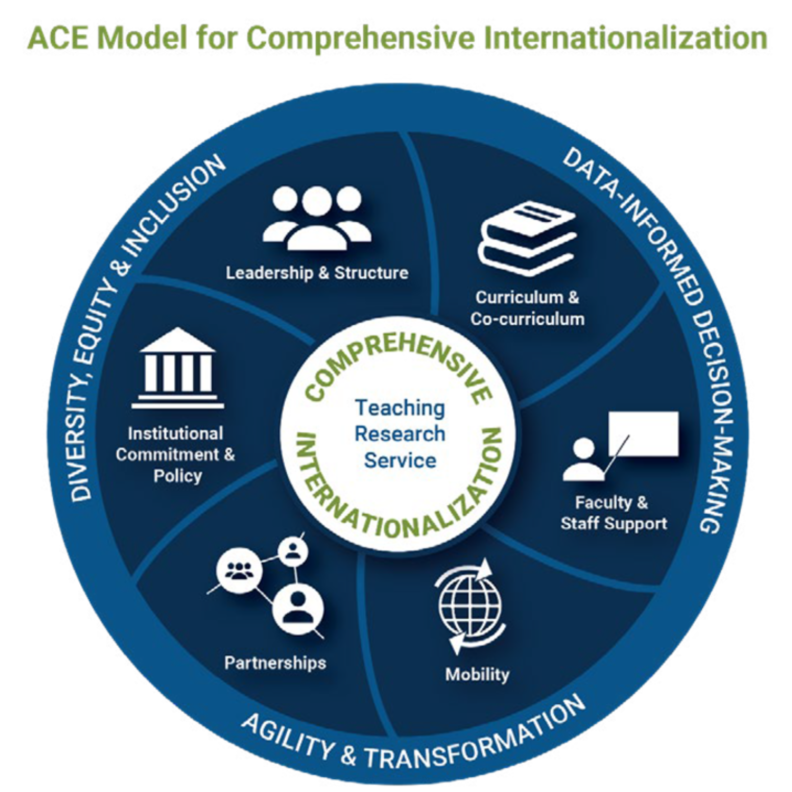
In addition to Washington State, eleven other institutions participated in the 20th cohort: California State Polytechnic University, Pomona; California State University, Stanislaus; Denison University (Ohio); FLACSO Ecuador; Kenyon College (Ohio); State University of New York at Rockland Community College; Southern Methodist University (Texas); Universidad del Azuay (Ecuador); Universidad Católica de Cuenca (Ecuador); Universidad Nacional del Chimborazo (Ecuador); and University of North Carolina, Asheville.
This report is based on a three-day visit to the Pullman campus of Washington State University by an ACE peer review team on October 14–16, 2024 and draws on the Washington State University Internationalization Lab Final Report: Pathways to Student Success and Scholarly Impact in a Global Context (hereafter, WSU Internationalization Final Report) (October 2024). The site visit included meetings with Provost Chris Riley-Tillman; Vice President for Finance & Administration Leslie Brunelli; Vice President for Strategy, Planning, and Analysis Chris Hoyt; Global Campus Chancellor, Interim Pullman Chancellor, and Vice President of Academic Outreach and Innovation Dave Cillay; provost’s leadership team; deans council; Chair of the Faculty Senate and the Senate Executive Team Tracey Klein; ACE Lab steering committees; the ACE Lab subcommittee chairs; the ACE Lab’s subcommittees (3); and the International Program Office, led by Interim Vice Provost Paul Whitney. A detailed schedule of meetings and list of invited attendees is included in Appendix I.
The report is organized into five sections, as follows: I. Executive Summary; II. Introduction; III. Peer Review Team; IV. Overall Strengths of the institution, and V. Observations and Recommendations.
This confidential peer review team report is designed to assist institutions that participate in the ACE Lab with their internationalization efforts. While we encourage wide internal distribution of the report so that it can assist the university community in these tasks, dissemination is entirely up to WSU. The contents will not be published or made public unless WSU so chooses or gives ACE permission to do so.
PEER REVIEW TEAM
David Fleshler
Senior Associate for Internationalization, ACE: Senior Fellow, Institute for International Education; former Vice Provost for International Affairs, Case Western Reserve University, Cleveland
Gil Latz
Senior Associate for Internationalization, ACE: Professor, Waseda University, Tokyo; Former Vice Provost for Global Strategies and International Affairs and Professor of Geography, The Ohio State University. Chair, peer review team
Penelope J. Pynes
Senior Associate for Internationalization, ACE: former Associate Provost for International Programs at the University of North Carolina Greensboro
OVERALL STRENGTHS
In the view of the peer review team, Washington State University is at a propitious moment in time to broaden and deepen its internationalization efforts. This conclusion is based on review of the WSU Internationalization Final Report, which clearly articulates the global research, learning, and engagement imperatives facing public higher education today; the 18 months of interaction between the WSU Lab
steering committee, ACE’s adviser, and peer review team Chair Gil Latz; the involvement of WSU’s Internationalization Lab cochairs in three milestone meetings at ACE headquarters in Washington, DC; and the October 14–16, 2024 site visit by three ACE-affiliated internationalization experts, which included meetings with senior administrative leadership, deans, the ACE Lab steering committees and subcommittee chairs, and faculty and staff leaders.
WSU’s overall strengths are reviewed in this section in terms of System Commitment, Senior Leadership Engagement, Committee Structure, Final Report Framework, and WSU’s National Benchmarking Exercise.
System Commitment
Washington State University is a public university system that includes six campuses, research and learning centers, and extension offices; the system’s main campus is in Pullman. In this report, the system framework is referred to as WSU.
WSU is classified as a Research I land grant institution. This designation confirms its recognition as a university with the highest level of research activity—one that shares an educational mission with other American land grant institutions established by the Morrill Act in 1862.3 The land grant public university mission articulated in the WSU Strategic Plan is exemplary in terms of this history, proclaiming that the university is “committed to the principles of practical education for all, scholarly inquiry that benefits society, and the sharing of expertise to positively impact the state and communities.”
It is significant to observe that WSU’s Strategic Plan’s mission is reinforced by a vision for educational excellence that aims for the university to “deepen and expand its impact by building on the strengths of each campus and location for a stronger Washington state and global community.” WSU’s vision statement is the logical starting point for the WSU Internationalization Final Report, which aims to, “(build on the university’s) strong foundation to achieve further…. internationalization success…. by ensuring that a global perspective is embedded in the culture of the colleges, campuses, and administrative units across the WSU system.
The cojoining of global engagement visions as found in the WSU Strategic Plan and the WSU Internationalization Final Report are exceptionally compelling in the view of the peer review team. Conversations with senior leaders noted that in combination, the strategic recommendations found in each document allow for coherence and prioritization of WSU’s thinking about its purpose as a globally engaged land grant institution. These recommendations establish goals and objectives that can be realized and measured. As noted by Interim Vice Provost for International Programs Paul Whitney and other faculty and staff leaders in both the opening and closing meetings of the campus visit, the recommendations found in the Internationalization Final Report are consistent with WSU’s distinctive approach to global learning and research that is rooted in past and present campus commitments to innovative scholarship, teaching, and entrepreneurial thinking.
Senior Leadership Engagement
The peer review team’s meetings confirm that academic and administrative campus leadership were engaged steadily and thoughtfully throughout the Lab process, contributing to the identification of ways that WSU’s mission could best address global challenges through focused integration of global learning in the university’s teaching, research, and service activities.
As articulated by members of the steering committee, participation in the ACE Lab allowed faculty and administrators as well as students and staff to collaborate across the institution. Moving beyond campus silos created a sense of integrated meaning through communication, cooperation, and coordination, a recognition that interdependent, cross-campus thinking is a key to WSU’s future success as a globally engaged institution. Indeed, this perspective is one of the most important findings of ACE Lab research and practice over the past two decades.
In conversation with Provost Chris Riley-Tillman, the value of WSU’s participation in the Lab was clearly recognized as a crucial first step toward consideration of global engagement as a university priority. The provost agrees with the report’s most important recommendation: to create a standing internationalization committee. As consensus emerges regarding the prioritization of internationalization—and pending the appointment of WSU’s next president, expected in the next six months—this committee could then be charged with implementation and operationalization of the recommendations found in the WSU Internationalization Final Report. The peer review team strongly endorses the provost’s thinking. Indeed, a first order of business for the to-be-established standing internationalization committee will be for the provost to facilitate an opportunity to discuss with the incoming president the findings and recommendations of the WSU Internationalization Final Report.
The provost along with other senior leadership interviewed also recognize that—similar to institutions of higher education across the U.S.—WSU now operates in an increasingly complicated geopolitical environment both nationally and globally. As a result, there are a number of emerging constraints associated with campus internationalization to contend with, ranging from the declining enrollment numbers for domestic students as well as the risk factors affecting student and scholar mobility that include health, safety, and intellectual property security concerns. The present-day public debates about the broad value of international education for public higher education in the U.S. as well as in Washington DC are expected to continue.
In the aggregate, the observations above underscore the significance the peer review team attributes to senior leadership’s commitment to support and explore the critically important tasks of crafting an emerging new global vision through a series of next steps that can operationalize and implement the recommendations of the WSU Internationalization Final Report as well as advance the goals of the university’s overall strategic plan.
Committee Structure
The ACE Lab Steering committee was convened in 2022 by then Executive Vice President and Provost Elizabeth Chilton to investigate the current and future prospect for internationalization at WSU.
The provost designated Asif Chaudry, then vice president for International Programs, and Paul Whitney, then associate vice president for International Programs, to be steering committee (SC) cochairs. The SC cochairs—in consultation with the provost—were charged with identifying the membership of the SC—one that reflected diverse campus representation to ensure broad faculty and administrative consultation and buy-in, including staff and faculty across WSU’s colleges/schools and units/areas. In addition, input from stakeholders across the campus was solicited throughout the Lab process.
To examine and make specific recommendations on various areas of internationalization at WSU, the SC created three subcommittees, each of which had representation from the Office of International Programs. The subcommittees were organized in terms of the following internationalization themes: Curriculum, Cocurriclum, Faculty, and Staff; Partnerships and Student/Scholar Mobility; and Institutional Planning, Leadership, and Policy.
The Lab steering committee was given an ambitious charge—one that was well executed thanks to the excellent leadership of the SC cochairs and the exemplary work of the SC subcommittees and their respective chairs. The SC and each of the subcommittees are commended for their careful formulation of a set of thoughtful and actionable recommendations based on university-wide data collection and conversations with students, faculty, and staff.
Final Report Framework
The WSU Internationalization Final Report’s one-page Executive Summary presents a concise and informative overview of the work of the SC and the SC’s subcommittees.
The Executive Summary is followed by the main body of the report, titled Internationalization: What, Why, and How. Within this section, the reader finds an Assessment of WSU’s Current Level of Internationalization and a detailed review of the Internationalization Goals and Strategies recommended for WSU.
The main report concludes with an overview, titled Next Steps on Our Continuing Path to Comprehensive Internationalization. The WSU Internationalization Final report contains two appendices. Appendix A consists of comprehensive reporting on the membership, scope of work, and summary recommendations of the three subcommittees. Appendix B is the Internationalization Benchmarking report that WSU commissioned from ACE based on the 2022 edition of Mapping Internationalization on U.S. Campuses, as discussed further below.
National Benchmarking Exercise
ACE Lab participants are encouraged to conduct a thorough assessment of the current state of their campus internationalization.
In WSU’s case, this exercise sought information through a commissioned report provided by ACE based on data from the 2022 edition of Mapping Internationalization on U.S. Campuses. A particularly useful aspect of the data organized was the report’s comparison of “responses across all universities with those of a group of peer and aspirational peer universities (that WSU) selected.”
Table 1, Key Findings from the ACE Benchmarking Exercise summarizes these findings. Five issues are highlighted regarding the state of internationalization at WSU in comparison to peer and aspirational peer universities:
- Reasons for internationalization
- Fundraising strategy for internationalization
- Establishment of a standing committee for support and assessment
- Global engagement themes for the curriculum
- Financial support of faculty and students to conduct global research and/or study abroad
As summarized in Table 1, internationalization at WSU was consistent with comparable institutions in terms of its stated reasons for global engagement. For the other four markers assessing internationalization, however, WSU either had not made comparable efforts or, when efforts could be compared, WSU’s approach was considered to be only partially coordinated centrally on campus or ad hoc.
Based on this analysis and the work of the subcommittees to identify WSU’s past, present, and future research, learning, and engagement priorities, the WSU Internationalization Final Report calls for the university to pursue a global impact vision, requiring a coordinated effort focusing on three high-level goals:
- Pathways to Preparing Students for Life and Work in a Global Context
- Maximizing International Opportunities for Scholarly and Educational Collaboration for Faculty and Students
- Establishing an Internationalization Culture Strongly Connected to WSU’s Mission and Strategic Planning
The main body of the Internationalization Final Report and Appendix A and B discuss targeted initiatives for each goal.
In pursuit of the WSU Internationalization Final Report’s three high-level goals, four overarching strategies are identified that further elevate and integrate the report’s recommendations as well as align global engagement efforts with the WSU Strategic Plan. These strategies are to:
- Establish a permanent representative committee focused on advancing internationalization and assessing progress
- Adopt a multi-level approach to support and extend departmental efforts that internationalize the curriculum and develop meaningful cocurricular opportunities so that all students systemwide become well prepared for the global context of modern life and careers
- Address barriers to international research and outreach and deepen WSU’s global impact
- Develop a formal strategy to raise money to support internationalization
Part V, Observations and Recommendations will discuss the WSU Internationalization Final Report’s overarching goals and associated strategies and objectives in more detail.
OBSERVATIONS & RECOMMENDATIONS
Introduction
During the peer review team site visit, conversations with the campus community identified the need for greater coordination of international education and global engagement efforts. The peer reviewers heard that while such activities were taking place, they were siloed and therefore not necessarily leading to greater global engagement in broad areas across the campus.
The WSU Internationalization Final Report takes a number of important steps forward in addressing the need for and ways to accomplish a more integrated and intentional approach to campus internationalization—one that contributes significantly to WSU’s maturation as a globally engaged institution. It is well written and organized, and one of its major strengths—as noted with respect to the findings of the three subcommittees—is a wide-ranging set of proposals and suggestions that build atop a solid university
foundation of significant global engagement informed by noteworthy research and curricular and cocurricular programs.
Features of the WSU Internationalization Final Report’s recommendations that can be further developed are discussed below. The intention of this section—based on report review, observations during the peer review site visit, and with reference to internationalization theory and practice—is to help WSU move from a set of strong international education programs (successful but disparate activities) to strategic internationalization. We focus on what we see as the primary questions and issues—attention to which promises to make the most difference—but also offer some suggestions about supporting activities.
Commentary begins by addressing three issues that are time sensitive: prioritization of the WSU Internationalization Final Report Recommendations; creation of a standing internationalization committee; and recruitment and integration of international students.
Observations by the peer review team then turn to extended review of three essential dimensions of comprehensive internationalization: expanding and deepening approaches to global learning; education abroad and study away; and identifying strategic international partnerships.
The peer review team report concludes with three shorter sections highlighting reflections on: organizing and communicating information on global reach and international alumni; rewards for curricular development and faculty research; and entrepreneurial thinking.
Observation #1: Prioritization of Recommendations
The WSU Internationalization Final Report concludes with a thoughtful summation of its recommendations, as found in the section on Next Steps in Our Continuing Path to Comprehensive Internationalization.
These steps include: prepare (WSU) students to thrive in a highly interconnected world; facilitate faculty and student scholarship and creative activity to have global impact; and establish and assess university-wide goals and metrics as part of WSU’s evolving strategic vision.
The subcommittee reports’ recommendations, however, are listed in numerical order. Prioritization of the associated recommendations and goals for each subcommittee is unfinished business for the WSU Lab steering committees. Criteria that could be used include: consensus ranking of and timeline for recommendations made by each subcommittee, e.g., one, three, and five years; cost to execute; and/or the challenges inherent to system-wide vs campus-level action. Parenthetically, there are benefits to be considered by distinguishing between system-level and campus-level goals for each of WSU’s six campuses.
In the overview, such prioritization will create agreed upon objectives for moving forward that facilitate communication outreach to campus and community stakeholders.
Observation #2: Standing Internationalization Committee
In their roles as a catalyst for internationalization, administrators, faculty, and staff across WSU can take pride in the institution’s accomplishments in global engagement. At the same time, major challenges remain.
Most importantly, internationalization efforts will need to continue to be campus-wide, with forward looking inclusion of all stakeholders, including students, colleges, the faculty senate, institutes and units, business and finance, and alumni. Conversations with campus stakeholders about why internationalization is important must continue since such dialogue will shape everything the university envisions.
A critically important factor for future success will be a committed core of faculty and staff who are willing to work together to achieve the goals identified by the WSU Internationalization Final Report. In this regard, the provost’s support for the recommendation to establish a standing internationalization committee is foundational. Coupled with it is the provost’s expectation that the 11 academic college deans also play a leadership role through representation on the standing internationalization committee.
Observation #3: Recruitment and Integration of International Students
The call for an increase in international student enrollment on WSU campuses is one of the main recommendations of the WSU Internationalization Final Report.
The cost dimensions associated with international enrollment are described as a main limiting factor in two respects: the need to more creatively utilize tuition waivers in support of international students; and for graduate students in particular, recognition and resolution of the lagging stipend levels for teaching and research appointments in comparison to peer institutions. As noted in the subcommittee recommendations,
The current budget structure at WSU limits the number of international graduate students who can be admitted to graduate programs through its tuition waiver programs.
Such financial issues are being addressed across the nation by ongoing efforts to educate campus stakeholders in the public, private, and NGO sectors about the ways international students contribute financially to lowering the costs of education for domestic students as well as the fact that they bring unique ideas that advance research, trade, and global understanding.
The peer review team concurs that comparative study of the differences between WSU graduate tuition stipends and those found at peer institutions is an important priority for the institution to assess. The question to be explored is how best to reach cross-campus consensus on the appropriate level of international student tuition to realize the goal of increasing enrollment.
Coming to terms with the issue associated with recruitment and integration of international students represents a significant opportunity. Its resolution allows for leveraging graduate student recruitment to drive WSU’s Research I scholarly agenda in alignment with the global engagement mission and vision for one of the nation’s important land grant institutions.
Observation #4: Expanding and Deepening Approaches to Global Learning
The peer review team encourages WSU to keep the fact that internationalizing curriculum and pedagogy is a long-term process front and center. It involves iterative discussions with stakeholders throughout the university to determine the desired student learning outcomes; identify innovative ways to spread global learning to all students; create opportunities in all programs for students to demonstrate, assess, and use this learning for continuous improvement; and integrate education abroad experiences into the curriculum, both prior
to departure and upon return from traditional education abroad programs and adapted to emerging virtual education abroad and study away initiatives (as discussed in Observation #5 to follow).
Coupled with institution-wide priorities, leadership for the realization of global learning goals resides with the faculty—in their role as researchers and instructors—and the staff—particularly those involved in cocurricular activities. This observation applies to both those currently at the institution and those who will be hired in the future. Current and prospective members of the campus community need to be incentivized to do this important work. For some faculty and staff, this will not be new learning; for others, it will be.
In either case, attention to the tenets of global learning give faculty and staff new ways to think about their research, teaching and student support efforts in a more nuanced fashion.Professional development at various levels will be necessary to help faculty members, department chairs, student affairs staff, and deans identify international and/or intercultural learning outcomes, enhance the international/intercultural content of current programs, and create education abroad and study away opportunities that will bring global perspectives to the disciplinary majors. Advertisements for new faculty and staff positions can emphasize that international experience or background is preferred so that the institution can augment its internationalization agenda. As the university’s international agenda continues to further develop and incorporate graduate education as well as faculty research, support for productive linkages between undergraduate and graduate training—as called out in the WSU Internationalization Final Report—will grow, befitting the intellectual climate of WSU as well as acknowledging national trends that prioritize undergraduate research mentoring.
We commend the faculty and staff for its ongoing effort to identify priorities for internationalizing curriculum and pedagogy appropriate to WSU. This is a key outcome of the benchmarking exercise conducted with ACE data (see IV, Overall Strengths), which calls for the university to pursue a global impact vision requiring a coordinated effort focusing on the high-level goal of developing Pathways to Preparing Students for Life and Work in a Global Context.
As these initiatives unfold, the peer review team confirms that curricular and cocurricular initiatives as well as assessment rubrics are key to realizing global learning objectives. The knowledge, attitudes, and skills obtained by embedding global learning themes in the curriculum are the exact attributes that will benefit
WSU graduates as they participate in the global marketplace as well as assume critically important responsibilities as citizens of the U.S. and the world.
As the WSU Internationalization Final Report proposes, University Common Requirements (UCORE), a general education program that helps undergraduate students acquire broad knowledge and transferable skills to complement their major programs of study, can be singled out for coordination with internationalization goals. Such steps—organized around a Global Engagement Certificate—will accelerate and deepen global learning at WSU and is strongly supported by the peer review team.
Along with integration of global learning themes and UCORE requirements, a less developed but equally important theme to explore is the potential link between WSU’s diversity initiatives and internationalization efforts—to recognize, in other words, that the characteristics of antiracism, diversity, equity, and inclusion vary across culture and intercultural competence is a common denominator for understanding historical and contemporary features of U.S. society as its ethnic makeup diversifies and in response to the “workforce ready” expectations of national and multinational employers. Deep interrogation of intercultural competence as an element of global learning objectives is one imperative of 21st century higher education both at home and abroad. In making this recommendation, the peer review team acknowledges that even as the national trend now shifts away from diversity, equity, and inclusion (DEI), there continues to be recognition at WSU about the importance of understanding the linkage between diversity and internationalization. The peer review team’s meetings on campus led us to conclude that while the cocurricular aspect of global learning is being pursued creatively at WSU, it can be developed further. As noted in the Curriculum, Cocurriculum, Faculty, and Staff Subcommittee recommendation 3, there is a proposal to create a dedicated cocurricular committee charged with conducting a needs assessment and providing system-wide oversight. Implementation of this recommendation encourages on-campus activities designed to more comprehensively include cocurriculum global learning themes in partnership with student life and residence hall leaders.
Many resources are available to assist the faculty in internationalizing the curriculum. ACE has posted or published successful examples from several projects. “Where Faculty Live”—disciplinary associations (American Political Science Association, American Psychological Association, American Historical Association, and the Association of American Geographers) represents one example describing what an internationalized major would look like. These disciplinary-specific guidelines need to be adapted to faculty-established priorities. In WSU’s case, such global learning and research opportunities will not necessarily be new. Rather, the opportunity is to expand on what already exists.
Observation # 5: Education Abroad and Study Away
WSU’s present-day student body—similar to many public universities in the U.S.—includes a significant percentage of first-generation university students. Supporting their burgeoning interest in global learning beyond the conventional classroom experience is well presented in the recommendations put forward by the Curriculum, Cocurriculum, Faculty, and Staff Subcommittee. The peer review team applauds the detailed information presented by this subcommittee, particularly as it relates to the impressive progress WSU now makes with respect to education abroad.
The peer review team would also like to make several observations about WSU’s efforts to reimagine traditional forms of off-campus global learning.
In the case of education abroad, the subcommittee recommendations thoughtfully recognize the challenges and opportunities facing first-generation college students participating in traditional education abroad programs, ranging from affordability, part-time work responsibilities, and the crucial role that advisers play in helping students feel that they are ready to face with confidence the inevitable unknowns of international travel and study. The roles of the WSU Advancement and Alumni Affairs Offices are identified in the WSU Internationalization Final Report—along with foundation support—to address the affordability issue. This fundraising priority pertains to bilateral exchange programs as well as faculty research that are international in scope. In recognition of the needs of all WSU students, education abroad programs can also serve to further expand the curriculum by providing content learning through courses not available on the WSU campus, which serves to deepen learning in the disciplines. In this regard, degree completion maps are a useful tool for select majors given that they can confirm—through careful planning—that time-to-degree-completion is not adversely affected through participation in education abroad.
Such approaches to education abroad and international experiences will be quite attractive to some departments, particularly in disciplines that nationally (and perhaps locally) have been less closely associated with education abroad programs.
The peer review team also encourages additional investigation and incentivization of alternatives to traditional education abroad such as faculty-led, short-term education abroad; internships and research experiences abroad; and incorporation of certificates, digital badges, or other transcript notations highlighting the knowledge acquired through education abroad that is of practical value when seeking employment.
The “study away/internationalization at home” option should not be overlooked. These programs pioneer creative ways to develop intercultural competencies without traveling abroad by devising experiential learning opportunities in partnership with local immigrant or indigenous communities. WSU’s Zoe Higheagle Strong, vice provost for Native American Relations and Programming, expressed interest in building a bridge between her portfolio of responsibility and International Programs during the provost’s council meeting with the peer review team.
Additionally—and as noted in the preceding Global Learning section of the peer review team report—the current rapid development of virtual education abroad programs and practices—through outreach initiatives as well as partnerships—are worthy of priority consideration by WSU. Such use of technology to meet global learning goals has grown by necessity during and since the COVID-19 pandemic, offering many new opportunities to engage with colleagues around the world to coteach courses or develop cocurricular programming. Utilizing digital technologies can complement and augment an institution’s international expertise as well as enhance curricular internationalization and encourage professional development through their inclusion in annual faculty/department/school reports.
One example of innovative technology for global learning is collaborative online international learning (COIL). COIL is an increasingly popular form of collaborative teaching and learning between classrooms and institutions in two or more countries facilitated by online communication.
Because the COIL approach is much more affordable, accessible, and scalable in comparison to physical education abroad, a wider range of students have been able to participate in and benefit from the experience of curriculum internationalization without leaving their home country. Indeed, COIL enables students to connect with peers and gain insights into cultures from multiple countries, concurrently or sequentially. As discussed in the peer review team report’s introductory section, WSU consists of five traditional campuses and a sixth Global Campus that provides online learning. WSU is therefore particularly well-positioned to explore ways that its Global Campus College could adopt COIL methodologies in support of global learning.
With regard to COIL technology, several important caveats are in order. The first is recognition that the tools now available in support of global learning serve to complement rather than substitute education abroad. At their best—and as increasingly reported in the research literature—such new learning modalities can play a powerful role by integrating classroom and educational experience across the disciplines.
Due to the diverse economic backgrounds of its students, putting in place technical capacities that are accessible to the campus community may be a challenge even at an institution hosting a Global Campus organized around online learning, as is the case at WSU. These challenges, nonetheless, also represent opportunities; support for developing relationships on campus between students of diverse backgrounds—in conjunction with students and faculty outside the U.S.—are of inestimable value. It is incumbent on the university to recognize as well as incentivize virtual face-to-face global learning activities. In sum, it is important to underscore that education abroad in all its forms is increasingly understood as a form of experiential learning that helps students develop operational skills as well as knowledge and attitudes to succeed in the workplace and through lifelong learning by acquiring such traits as: flexibility, confidence, problem-solving, self-knowledge, curiosity, and tolerance.
Observation #6: Identifying Strategic International Partnerships
The purpose and potential of international partnerships was discussed throughout WSU’s participation in the Lab and during the peer review team’s site visit.
The peer review team agrees with administrative and academic leadership that WSU should consider identifying two to three strategic partnerships capable of integrating and elevating system-wide internationalization in the years ahead. In doing so, a fundamental question accompanying all international partnerships in higher education will need to be addressed—one that is of keen interest to administrators, faculty governance bodies, academic departments, and faculty, students, staff, and community stakeholders alike: How are signature programs identified and pursued as strategic opportunities for the campus?
Susan Sutton, a leading expert in the field and a fellow ACE Lab Adviser, has written persuasively on the value of strategic academic partnerships to pursue internationalization goals. Strategic partnerships are those with campus-wide significance that involve and coordinate multiple schools and units. They represent an institutional commitment to a long-term, sustainable relationship. They are intended to provide platforms for deep, cumulative learning, research, and engagement, such that new projects build on previous ones, students encounter partners in a wide variety of courses and cocurricular activities, and long-standing relationships are fostered between each institution in the relationship and their respective partner communities. Sutton notes,
The forces now impelling internationalization have dialogue and collaboration at their core. This realization moves the exchanges and partnerships in which our institutions have long engaged to the center of any internationalization strategy. And these relationships, in turn, can become the means by which our institutions collectively move forward together. For international partnerships to play such a role, however, we must rethink what they are about and how we can best develop and sustain them . . . by transforming . . . traditional modes of exchange into more full-bodied relationships, moving from what might be called transactional partnerships to transformational ones.
The distinction between transactional and transformational partnerships is crucial as WSU further develops a strategic approach to internationalization.
Historically, most international academic partnerships can be characterized as follows: supported by only a few faculty members (or even a single faculty member); sending a few students/faculty back and forth;
occasionally engaged in joint projects; and lasting as long as their original proposers were interested and often (sometimes immediately) idle thereafter. Such partnerships, in other words, were transactional—simple give-and-take relationships where neither institution is much changed by the exchange and in effect, instrumental in nature and predicated on trading resources.
Transformative partnerships can be distinguished as follows: change occurs in both institutions as they work together; common goals, projects, and products are generated through combined resources; there is an
emphasis on the relationship as much as the product; the relationship expands over time; and a dialogical basis for global learning takes place. In short, transformative partnerships are binational communities of higher education in which there is a constant flow of people, ideas, and projects back and forth as well as development of new projects and common goals.
The senior international officer on campus leads the identification and execution of academic partnerships based on strategic planning priorities. This leadership role is supported by a steering (or other) committee guided by a set of criteria applied consistently on a case-by-case basis, ideally represented in concrete form by a map or inventory that expects:
- Campus-wide conversation, engagement, and approval that result from lengthy discussions with partner institutions
- Long-term commitments to develop the relationship over time through identification of new projects and common goals
- Involvement of faculty with international expertise as well as faculty who know little about the partner country or have no international background
- A deepening over time of complex understandings and sense of mutual responsibility
- Student learning across the curriculum for both institutions by modeling the cross-national competencies we want for our students
- Joint research and development projects on new topics
- Creative interdisciplinarity
- Involvement of administrators and staff
- Economies of scale/synergies of effort
- Concentrations of activity that attract external funding
- Community engagement on both sides
- Resource allocation from both institutions through sharing and collaboration
- Partnership persistence over time and beyond the original proposers
Because they are intensive and extensive, strategic international partnerships that involve the whole campus are by definition few in number. Prospective partnerships have to be selected carefully and pursued patiently and persistently. It is a strategic investment in a relationship that will involve the whole campus—distinct from an overseas study program or exchange program that might involve a single department or degree program. Such outward-looking internationalization reflects an academic organization’s engagement in the global construction of knowledge as well as a willingness to grow from dialogue and exchange. The
role and nature of higher education in a globalizing world places reciprocal, transformative partnerships at the center of campus internationalization. As such, they should recognize that there is a complicated political
calculus that must be considered—one that regularly demonstrates that internationalization benefits the WSU campus as well as the local, state, and national community through collaborative global partnerships.
As found in a number of key references, standards and practices are now evolving in support of international partnerships. ACE’s International Higher Education Partnerships: A Global Review of Standards and Practices
is a comprehensive review of “standards of good practice for international higher education partnerships set forth by a variety of organizations (in the United States and around the world).” The publication’s focus is twofold: program administration and management (transparency and accountability; faculty and staff engagement; quality assurance; and strategic planning and the role of institutional leadership); and cultural and contextual issues (cultural awareness; access and equity; institutional and human capacity building; ethical dilemmas and “negotiated space”). The Institute of International Education has also conducted research on strategic international partnerships that includes case studies from around the world.
Observation #7: Organizing and Communicating Information on Global Reach and International Alumni
As discussed in detail in the WSU Internationalization Final Report, the use and updating of internationalization data can be an ongoing legacy of the Lab steering committee’s work. The peer review team recommends that the information collected during the Lab process be organized and made available so that faculty and administrators have access to it in support of ongoing internationalization efforts. These data can help WSU explore a range of important topics: broadly, in terms of the university’s global reach; and specifically, in terms of international partnership tracking as well as the identification and outcomes of collaborative teaching opportunities. There are numerous campus benefits to making such information available in an easy-to-search, digital format.
Research by ACE and others also confirm that one key to effective internationalization is the role of compelling storytelling. WSU has an impressive set of global accomplishments in terms of its teaching, research, and engagement. Yet in review of the WSU Internationalization Final Report and WSU profiles online, communication of these accomplishments is modest, and future global aspirations are only partially developed.
The peer review team recommends that the Lab steering committee engage campus communication experts in crafting a persuasive argument on “making the case for internationalization” at, for, and by WSU— one that builds on its distinctive character as an institution of higher learning in the U.S. Such collaborative work will build evermore durable relationships with key stakeholders as an internationalization strategy is implemented in the months and years ahead. In such endeavors, thought must be given to how the data are updated—something that can be accomplished by structuring year-end reports from faculty and deans.
In short, a key point as the WSU Internationalization Final Report considers implementation of its recommendations is to communicate how internationalization efforts are furthering values and strategies associated with WSU’s unique mission and vision. This can be done in two ways: by addressing the interconnected and interdependent global challenges confronting the campus, the state of Washington, DC, the nation, and the world; and by identifying how the passions of WSU’s faculty and students contribute to solving urgent world issues of the day. Finally, WSU has begun to explore the question of how international alumni can be engaged to further the campus’ internationalization strategy. Priority identification of the characteristics of international alumni allows for consideration of ways to create a system for tracking their location, interests, and engagement with WSU. Alumni can assist their alma mater with international student recruitment and the development of exchange programs. They may be interested in providing donations in support of international activities and other campus priorities. Alumni are also often well positioned to offer international internship opportunities for students.
Observation #8: Rewards for Research and Curricular Development
The peer review team encourages further thought by WSU on a plan for curricular enhancement grants and targeted faculty incentive programs (salary enhancements; research/travel dollars; or course releases) to further the work of internationalization. Continuing support for existing rewards as well as consideration of new awards brings attention to the importance of curricular internationalization and showcases outstanding students, faculty, and staff.
Observation #9: Entrepreneurial Thinking
At its core, the Lab engages each participating institution in crafting and implementing a strategy for academic change. As such, it encourages individual as well as institutional-level entrepreneurial thinking based on the recognition that colleges and universities place “sense making” at the center of planning; are value-driven institutions where words, goals, and mission matter; are predicated on distributed leadership structures; embrace the ideal of shared governance; and recognize different constituencies with different goals.
In this framework, comprehensive internationalization must answer the question: why are we doing this? Answers usually include:
- Enhancing institutional reputation and competitive position
- Preparing students for global citizenship
- Making students more competitive in the global marketplace
- Generating revenue
- Enhancing the research agenda
- Enacting an institutional research and teaching mission to engage with an increasingly globalized world
- Making a better, more understanding world
Conclusion
WSU is clearly fortunate to have strong support for internationalization from many faculty and administrators. Conversations about internationalization should continue in order to widen this base of support in order to realize WSU’s institutional mission and vision in terms of internationalization priorities and by preparing its students to be leaders in an increasingly globally connected world.
Over the course of its participation in the ACE Lab, WSU has made remarkable progress on developing a set of recommendations for supporting internationalization. The academic content accompanying these efforts—whether research, curricular or cocurricular, or through community engagement—needs to follow closely behind. The institution is well-positioned to continue its work in internationalization because it has all the key ingredients: leadership, energy, and a sense of direction.
Internationalization is a long-term project that requires commitment from top administrators who regularly reiterate and underscore the reasons why the campus and its programs (like all of higher education) must become more fully internationalized. This requires adequate resources, accountability, and regular evaluation and assessment. By developing and continuing an intentional process, WSU will make internationalization goals part of its everyday operations, continuing to reinforce its status as a distinguished and distinctive Research I land grant institution.